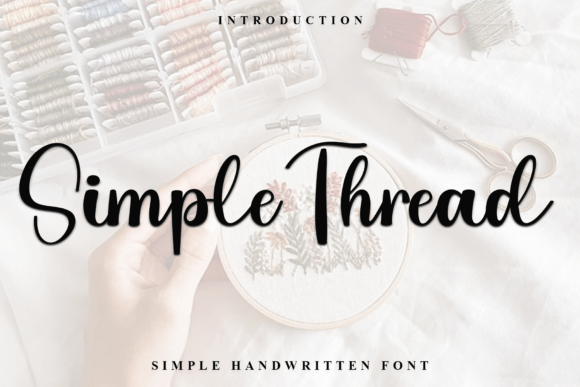
Simple Thread: A Warm, Playful Script Font for Handmade Brands
If you've ever spent hours tweaking a label, re-cutting vinyl because the script didn’t flow right on your Cricut, or hesitated before listing a printable invitation set because the font felt *too stiff* or *too fussy*, then Simple Thread is the kind of script font that quietly solves real problems. It’s not just another decorative typeface — it’s a relaxed, round, friendly script from Script Amp that breathes warmth into every letter. As someone who designs printable wall art, sews boutique gift tags, and prints seasonal candle labels for my small shop, I reach for Simple Thread when I need charm without compromise.
What makes Simple Thread stand out isn’t just its soft curves or open counters — it’s how approachable it feels at every size. The strokes are gently rounded, never sharp or overly stylized, so it reads clearly even at 14pt on a product tag or 20pt on a kraft paper sticker. That balance between personality and practicality is rare in script fonts. Unlike some handwritten fonts that blur or collapse at small sizes, Simple Thread holds its shape beautifully on printed cards, die-cut labels, and SVG-based iron-on transfers.
I use Simple Thread across my physical product line: on hand-stamped tea towel tags, wedding welcome boards cut from birch plywood, holiday mugs with minimalist phrases like “Cozy Season,” and even as the hero font on reusable tote bag designs. Its relaxed rhythm works especially well for farmhouse-style signs (“Gather Here”), botanical-themed planner stickers (“Bloom Daily”), and baby shower invitations where warmth matters more than formality. Because the baseline is stable and spacing is generous, it cuts cleanly on Silhouette Cameo and Glowforge machines — no overlapping letters, no finicky kerning adjustments mid-project.
For digital printables, Simple Thread shines in downloadable wall art sets — think framed quotes like “Home is Where the Heart Is” or “Good Things Take Time.” Its friendly weight gives instant character without overwhelming the layout. On greeting cards, it pairs naturally with clean sans serif fonts (like Montserrat or Poppins) for body text — the contrast keeps things legible while letting the script do the emotional heavy lifting. When designing packaging for handmade soap or bath salts, I often use Simple Thread for the product name (“Lavender Dream”) and switch to a light serif or geometric sans for ingredients and weight details. That pairing builds brand consistency while keeping shelf appeal high.
It’s worth noting that Simple Thread is designed as a display font — best for headlines, names, short phrases, and decorative wording. Don’t try to set full paragraphs in it. But for anything under 8 words? It sings. Think: “Made With Love,” “Small Batch,” “Est. 2022,” or “Thank You” stamped on a thank-you card. Even single-word uses — like “Yes” on a bridal shower banner or “Hello” on a front-door chalkboard sign — land with sincerity, not pretension.
The font includes OpenType features like standard ligatures and stylistic alternates, which add subtle variation when you’re layering text in Canva or Illustrator. I’ve used the alternate lowercase “a” and “g” to break up repetition in multi-line SVG quotes, and the built-in swashes (on capital letters) give just enough flourish for wedding stationery without veering into over-the-top territory. File formats include OTF and TTF, so it loads reliably in Cricut Design Space, Silhouette Studio, Adobe Creative Cloud, and even free tools like Inkscape. While multilingual support isn’t extensive, it covers basic Latin characters needed for English, Spanish, and French product labels — perfect for Etsy sellers shipping internationally.
Readability tips for crafters: For vinyl cutting, stick to sizes 24pt and up on curved surfaces (like mugs or jars), and always test cut a small phrase first — Simple Thread’s consistent stroke width means fewer surprises. On matte paper stickers, it prints crisply down to 16pt. For embroidery digitizing, simplify by using only the uppercase version — the clean lines translate better to stitch files. And if you’re mocking up social media graphics or Etsy listings, preview your design at 50% zoom: if it still feels warm and legible, you’ve nailed it.
Pairing Simple Thread thoughtfully elevates your whole product line. Try it with a warm, low-contrast sans serif (like Quicksand or Nunito) for modern stationery, or contrast it against a sturdy serif (like Playfair Display) for vintage-inspired apothecary labels. Avoid pairing it with other busy scripts — let Simple Thread be the voice, not part of a chorus. One of my best-selling printable bundles uses Simple Thread for titles and a neutral monoline sans for bullet points and instructions — customers consistently comment on how “inviting” and “easy to read” the layout feels.
And yes — this is a commercial font with a clear license for physical products, digital downloads, templates, SVG files, and client work. You can legally use Simple Thread on merchandise you sell (t-shirts, mugs, tote bags), in editable Canva templates, and on printable party kits you list on Etsy. Just make sure you’ve purchased the full commercial license — not the free trial version — before uploading files to your shop. That peace of mind matters when you're scaling beyond hobby status.
At its core, Simple Thread isn’t about trendiness — it’s about resonance. It’s the font that makes a customer pause at your booth, pick up your candle, and smile before reading the label. It’s the quiet confidence behind “handmade” that says *I care about how this feels, not just how it looks*. Whether you're printing 10 wedding invites or 10,000 holiday tags, Simple Thread delivers warmth, clarity, and craft-forward reliability — all in one thoughtful typeface.