Smile Dream: A Stylish Script Font for Modern Web Design
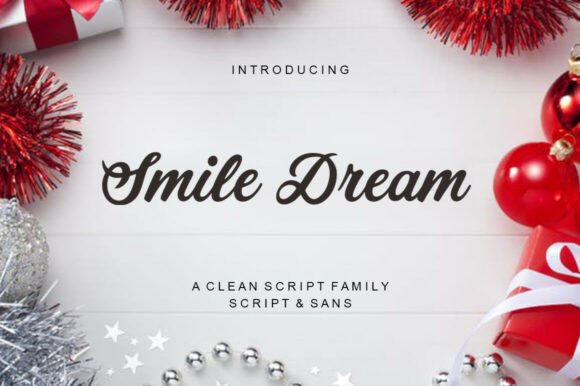
As a UI designer who builds landing pages, SaaS dashboards, and boutique e-commerce experiences, I reach for script fonts sparingly—but intentionally. Smile Dream stands out in the Script Amp category not because it’s flashy, but because it balances elegance with digital clarity. Its graceful strokes, fluid curves, and hand-drawn warmth translate exceptionally well on screen—especially when used where personality and polish matter most.
Smile Dream is a contemporary script font that avoids the pitfalls of overly ornate or fragile letterforms. Each character is carefully crafted for legibility at larger sizes, with open counters, consistent spacing, and subtle contrast between thick and thin strokes. It doesn’t try to mimic traditional calligraphy—it interprets it through a clean, modern lens. That makes it ideal for digital interfaces where tone and trust go hand-in-hand with usability.
Where Smile Dream Earns Its Place on Screen
In practice, Smile Dream shines as a display font—not body copy. Think hero section headlines, product name treatments, testimonial quotes, course titles, and branded section headers. On a coaching website, it transforms “Your Journey Starts Here” into something warm and human—not sterile or algorithmic. In an online store banner, it adds quiet sophistication to a limited-edition collection headline without competing with product imagery.
It works especially well in conversion-focused layouts. A CTA button labeled “Begin Your Free Trial” gains emotional resonance when set in Smile Dream—provided it’s sized appropriately (minimum 24px on desktop, 20px on mobile) and paired with sufficient contrast. I’ve tested it over soft gradient backgrounds and light image overlays: with a subtle text shadow or background tint, readability remains strong even at 18px on high-DPI screens.
Readability & Responsiveness: Practical Notes
Smile Dream isn’t designed for paragraphs—but it holds up remarkably well in short-form contexts across devices. On mobile, I use it exclusively for top-level headings (H1/H2), never for buttons smaller than 44px tall. Its curves remain distinct at 20px on iOS Safari and Chrome Android when rendered via WOFF2 webfont files. For dark mode interfaces, I pair it with a light fill (#F8F9FA) and a 1px soft drop shadow to preserve shape definition against deep backgrounds.
The font includes standard Latin characters, basic punctuation, and ligatures that enhance flow in phrases like “love,” “forever,” or “create.” While it doesn’t support extended Cyrillic or Arabic scripts, its OpenType features include stylistic alternates—useful for avoiding repetitive letter combinations in repeated branding (e.g., logo lockups or social media banners).
Font Pairing That Supports Clarity and Voice
Smile Dream thrives in contrast. I almost always pair it with a neutral sans serif—like Inter, Poppins, or Manrope—for body text, navigation, and interface labels. This creates clear visual hierarchy: Smile Dream sets the emotional tone; the sans serif delivers information efficiently. For editorial sites or premium course platforms, I’ll occasionally swap in a gentle serif (e.g., Lora or Cormorant Garamond) for blog headers or quote blocks—adding texture while keeping the script font as the sole expressive voice.
Avoid pairing Smile Dream with other decorative fonts or condensed sans serifs. Its rhythm relies on breathing room. In Figma or Webflow, I maintain at least 1.5× line height between Smile Dream headings and supporting text—and I never let it compete with icons or illustrations for visual weight.
Real-World Digital Use Cases
- Creative portfolios: Used for the site title and project category headers—giving immediate impression of craftsmanship without sacrificing scannability.
- Boutique online stores: Applied to collection names (“Spring Edit,” “Handmade Ceramics”) and limited-time offers—enhancing perceived value and curation.
- Coaching & course sales pages: Sets the headline above the email capture form—softening the ask and reinforcing empathy-driven positioning.
- Brand kits & digital assets: Included as the primary display font in Figma design systems and Notion brand guidelines—ensuring consistency across websites, social graphics, and email headers.
- Landing pages for creative tools: Used in animated typewriter reveals for taglines—its natural flow supports micro-interactions better than rigid geometric scripts.
Licensing & Implementation Essentials
Smile Dream is a commercial font, and its license explicitly covers web use—including self-hosted WOFF2 files, CDN delivery, and integration into client-facing SaaS products and online stores. When licensing for agency work, I confirm whether the plan includes unlimited domains or requires per-project registration. For template marketplaces or digital product bundles, I verify redistribution rights before including Smile Dream in downloadable assets.
It ships in OTF, WOFF, and WOFF2 formats—no variable axis, but full cross-browser support from Chrome 60+ and Safari 12.1+. No JavaScript dependencies or third-party font services are needed for reliable loading. I preload the WOFF2 file in the and apply font-display: swap to prevent invisible text during load—keeping perceived performance tight.
Ultimately, Smile Dream earns its place not by being everywhere—but by being *exactly right* where it appears. It supports brand identity without demanding attention, enhances emotional connection without obscuring meaning, and adapts to responsive layouts without breaking rhythm. In an ecosystem crowded with generic sans serifs and overused handwriting fonts, Smile Dream delivers considered elegance—one pixel-perfect curve at a time.